
St. Paul sewer & drain cleaning done right the first time
Older St. Paul neighborhoods sit on clay main lines with bell-and-spigot joints — the ideal place for tree roots to break in. That is why nearly every St. Paul main-line call we run gets a camera on it. Kitchen sinks, tubs, floor drains, main lines, and camera-guided diagnostics for St. Paul homeowners and businesses.
Camera view of a clay-pipe joint in a St. Paul main line — the exact style of pipe that lets roots in.
804 miles of city sewer — and the MCES grant that helps St. Paul homeowners fix their lateral
The City of Saint Paul Public Works Sewer Utility Division uses the terms Pipelining and Cleaning and Televising for the exact work most homeowners actually need. If your private sewer service (the line from your house to the public main) is failing, MCES pass-through grant funding administered by the city can cover up to $10,000 of qualifying repair work.
St. Paul maintains 804 mi of sanitary sewer and 450 mi of storm sewer serving 74,000 private services connected to 1,000+ mi of private lateral lines.
What we see in St. Paul homes
St. Paul is one of the oldest cities in Minnesota, and its housing stock reflects it — block after block of turn-of-the-century Victorians, 1920s bungalows, and pre-war duplexes with original clay laterals still in the ground.
Housing stock: Many St. Paul homes were built before 1940, especially in Summit-University, Cathedral Hill, Payne-Phalen, Frogtown, Como, West Seventh, and Dayton’s Bluff. That means clay laterals with bell-and-spigot joints are the norm, not the exception.
Common pipe material: Clay from the house to the property line is the dominant material in the older core. Newer neighborhoods on the East and Northeast edges of the city (Battle Creek, Highwood, parts of North End) have PVC or cast iron.
What we see most in St. Paul: Root intrusion at clay joints, offset joints from tree roots and freeze/thaw, kitchen-line grease buildup in older duplexes, and slow main lines that need a camera before anyone decides on the fix.
Neighborhoods and areas we regularly work in: Grand Avenue, Highland Park, Mac-Groveland, Summit Hill, Cathedral Hill, Como, Payne-Phalen, Frogtown, West Seventh, Dayton’s Bluff, and Downtown.
St. Paul ZIP codes, grouped by neighborhood
St. Paul has more than 30 standard ZIP codes. Here is how the map lines up with the neighborhoods we drive to every week.
If your St. Paul ZIP is not listed, call 612-382-7397 — we serve the entire city and most surrounding first-ring suburbs.
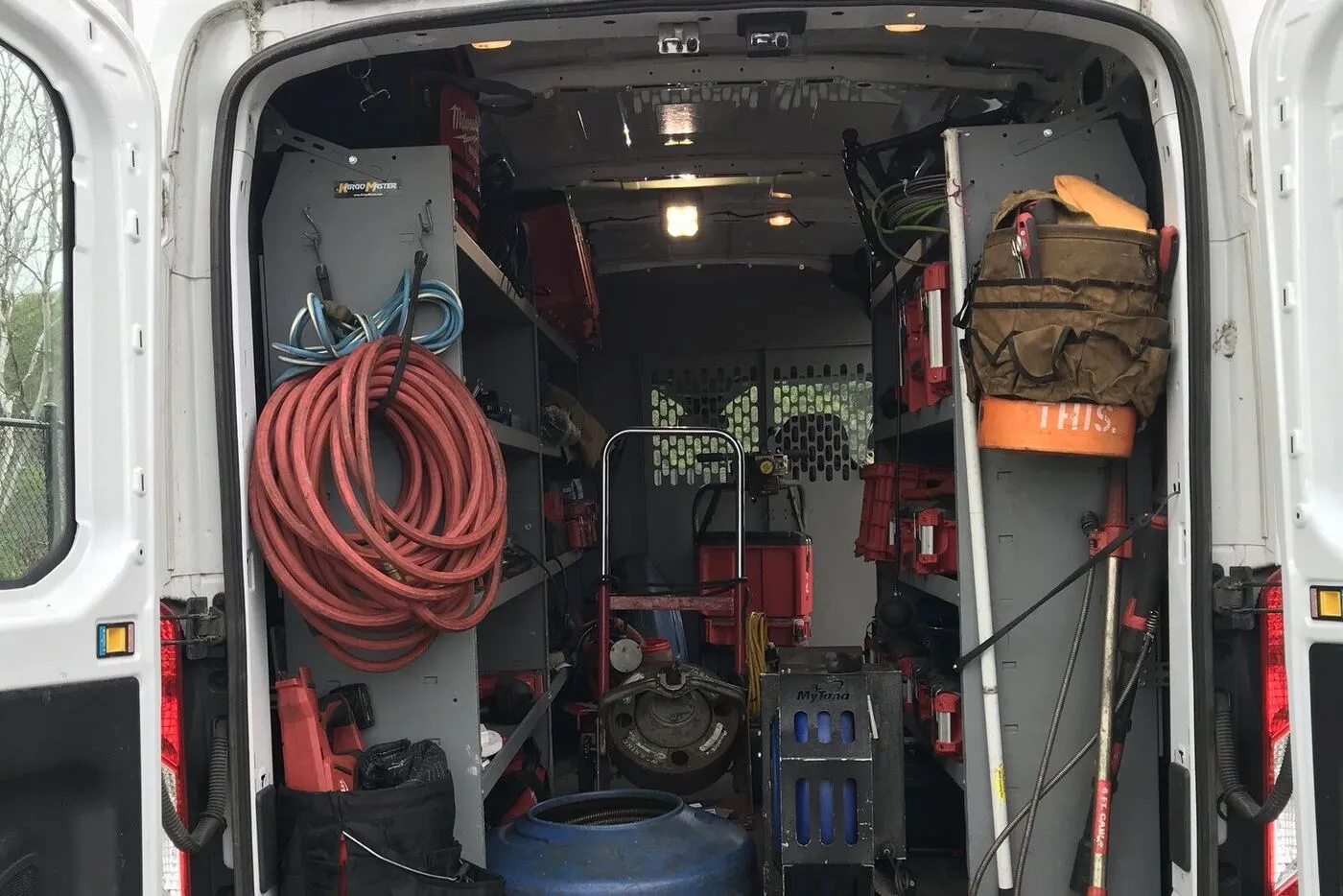
What St. Paul looks like from our van
Real photos from real service calls — we’re out here every week.

Who handles what in St. Paul
Sanitary sewer service in St. Paul is run by St. Paul Public Works — Sewer Utility Division, which feeds into the Metropolitan Council’s regional wastewater system. Here is who to call for what, plus the pipe realities that shape service calls in the city.
Services for St. Paul homeowners & businesses
The full drain and sewer toolkit — not just cabling. If it flows out of your house, we service it.
Drain cleaning
Kitchen sinks, tubs, showers, laundry, and floor drains cleared same day.
Main sewer line cleaning
House-to-street line cabling and hydro jetting for backups and slow drains system-wide.
Hydro jetting
High-pressure water scours grease, sludge, and roots to bare pipe.
Sewer camera inspection
See exactly what is inside your line, with video you can keep.
Homebuyer camera inspection
Scope the sewer before you buy and avoid inheriting a repair bill.
Trenchless pipe repair
Rebuild a failing line from the inside — no digging up the yard.
Grease trap service
Pump-out, scraping, jetting, and disposal records for food service.
Emergency service
Sewage backing up? Water where it should not be? Call 612-382-7397 anytime.
Citywide pipeburst season plus Frogtown and North End lead line replacements
What's happening in St. Paul right now
Saint Paul Regional Water Services has a long 2026 water main list running at once: pipeburst replacements on Sherman St, Saratoga St S, Otto Ave, Ross Ave, Bidwell St, Park St, Winona St E, Wyoming St E, and 4th St, plus trenchless lining work on Pigs Eye Rd and in the Lawson Forest and Dayton & Portland areas. Alongside that, the Frogtown, North End, Payne Phalen, West Side, Orange Forest, and Case Van Dyke Lead Replacement Projects are digging up service lines block by block, and Ramsey County has its own rebuilds moving on Rice St Phase II, Dale St (Iglehart to Grand), and Jackson St (Rose to Wheelock) — all layered on top of MnDOT's I-35E/Shepard Rd bridge work (Saint Paul Regional Water Services).
What this means for your drains
St. Paul has some of the oldest housing stock in the state — entire blocks still running original clay and Orangeburg (tar-paper) laterals from before 1930, decades older than almost anywhere else in the metro. Pipeburst and lead-line work digs right next to those old laterals, and here's what that tends to surface:
- Cracked laterals near pipeburst sites — the pipe-bursting method used on Sherman, Saratoga, Otto, and similar streets fractures the old main outward, and the shockwave can open hairline cracks in adjacent clay or Orangeburg service lines that were already brittle
- Root intrusion in Frogtown and North End — mature boulevard trees in these lead-replacement zones have spent 60-90+ years growing into pipe joints; disturbing the ground around them accelerates root intrusion into cracked clay
- Basement backups on county rebuild streets — homes along Rice St, Dale St, and Jackson St often still tie into 1920s-40s sanitary mains; heavy equipment traffic during Phase II work can settle bedding and create new sags in the lateral
If you're near the pipeburst or lead-replacement zones
If your home is in Frogtown, the North End, Payne Phalen, or along any of this year's pipeburst streets and your lateral hasn't been camera-scoped, this is a good window to get it done before winter — we hand you the video on a USB stick so you can see exactly what's between your house and the main.
Call 612-382-7397 or book a camera inspection.
Source: Saint Paul Regional Water Services — 2026 Water Construction Projects · MnDOT Construction Projects
Source: Saint Paul Regional Water Services · Updated 2026-07-22
Straight answers, honest work, the right method for your line
Local, not a franchise
Owner-operated, serving St. Paul daily. When you call, you get the person doing the work — not a call center.
Camera-equipped
Every main line clog gets a look. You see what we see. No mystery invoices, no upsell for repairs that are not needed.
Right tool for the job
Cable, jet, or camera-guided repair — we match the method to the actual problem, not to the biggest ticket.
Same-day, most days
St. Paul is inside our normal daily route. If you call before mid-afternoon, most days we can be out today.
St. Paul and the surrounding area
Sewer or drain problem in St. Paul?
Tell us what is going on and we will follow up fast — usually same day.
Frequently asked questions — St. Paul
How fast can you get to St. Paul?
We typically respond same-day for drain calls in St. Paul. Call 612-382-7397 in the morning for best odds of same-day service; we'll give you an honest ETA before we roll.
Do you serve every ZIP code in St. Paul?
Yes — we cover the ZIP codes serving St. Paul (55101, 55102, 55103, 55104, 55105, 55106, 55107, 55108, 55114, 55116, 55117, 55119, 55130, 55155, 55164, and 55170) and the surrounding community. Call to confirm your address.
What's the most common drain problem in St. Paul?
St. Paul is one of the oldest cities in Minnesota, and its housing stock reflects it — block after block of turn-of-the-century Victorians, 1920s bungalows, and pre-war duplexes with original clay laterals still in the ground. Housing stock: Many St. Paul homes were built before 1940, especially in Summit-University, Cathedral Hill, Payne-Phalen, Frogtown, Como, West Seventh, and Dayton’s Bluff. That…